What does an AI-assisted writing process look like?
I use AI frequently and reluctantly. Let’s just start there. My first experience using AI to generate content stretches back to 2022 when I dipped a toe into a tool called Jasper.ai. It cost $60/month back then (this was just before ChatGPT Launched in November that year). I wanted to see what kind of content it produced so I could explain to my clients why it was bad. And, boy, was it bad.
About six months after I started using Jasper, OpenAI made ChatGPT available to the world. I pivoted to ChatGPT and was similarly underwhelmed by its output. We’ve come a long way since those early versions of LLMs which worked from their (outdated) training data entirely. They couldn’t perform web searches or do anything remotely agentic either, so it was clunky to incorporate them into a writing workflow.
That’s no longer the case, of course. Now I have a fairly comprehensive AI writing workflow that has made me about 20% to 30% more productive when it comes to writing and easily 50-60% more productive when it comes to writing-adjacent tasks like incorporating interview content from SMEs, developing outlines, researching stats and trends, and reviewing drafts for editorial compliance. I am a writer and thus my AI-writing process comes from this perspective (versus a nonwriter who is spearheading an entire company’s content creation process). Here’s what that looks like:
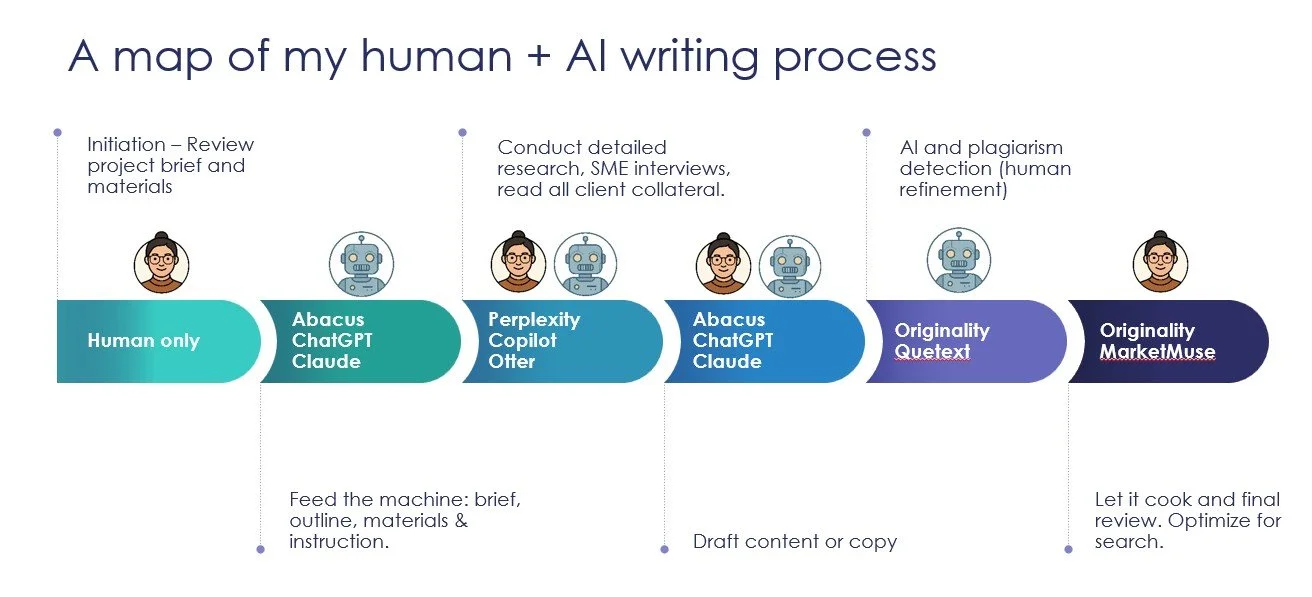
The above chart represents Jackie’s six stages of content creation including:
Intiation/Kickoff: This typically includes reviewing a supplied project or content brief, background materials, and a kickoff call to discuss goals and strategy, SEO considerations, deadlines, and anything else related to the specific content project. This part is driven by me. To the extent that AI is involved, it’s usually from the client side (e.g., an AI-created brief) and in the use of dictation software like Otter or Fyxer that captures my meeting. I love these tools, by the way. I haven’t taken manual notes since I started using Otter around 2019 or so.
Feed the machine: This is my robotic overlord’s favorite step in the content creation process. It’s also something I have come to enjoy. I create a project in Claude or Abacus (lately, I’ve been using Abacus and Claude almost exclusively). I add all relevant materials to the project including a brief or outline, background source material, meeting notes, AI guardrails and writing guidelines.
Research and analysis: This is a largely human endeavor that may include interviewing subject matter experts, reviewing client materials, and pulling in third-party research to support a piece. I’ve used Perplexity to pull research together in the past, but Google Gemini has gotten much better at pulling information (and sourcing that information) that it’s become my first choice tool. I still read or skim source information versus relying entirely on AI to synthesize information because a lot can go wrong.
Draft the content: This is all me, baby! Well, actually, I do use Claude or other tools to help with content writing now, but this process is still driven by me and always involves a generous amount of my own writing (to shape the narrative and voice). I plan to create a blog post that details what AI writing means to a self-identified writer - what does it look like? It’s complicated and kind of painstaking and deserves its own focus.
AI and plagiarism detection: I’ve used several tools to scan for AI tells and detect plagiarism including GPTZero, CopyLeaks, Originality.ai and (my latest favoite) Pangram. I once paid for a separate plagiarism-detection tool (quetext) but most AI detectors now have a plagiarism scan feature so it felt like overkill.
SEO refinement and final editorial review: The final step in my process is about 90% human. I do like to feed a list of targeted keywords into my LLM of choice along with my finished draft and ask it to provide suggestions, but I also do this myself when I give my piece a final read. Before reading the finished piece, I let it sit overnight (or “let it cook”), assuming I have wiggle room with the deadline. Then I read the piece with a fresh brain in the morning (slowly, deliberately, with an eye for SEO opportunities, readability, and tone). This editorial step is an important part of the human writing process. It’s what turns a good piece into a great piece. Highly recommend.
Writing, whether it’s created with the help of AI or not, should offer value, read like a human wrote it, and achieve the goals stated on the project brief or outline. This can’t be achieved (yet) if you feed all your source materials into an LLM and ask it to create the full draft, then don’t bother to go back and read it or edit it.
A rule of thumb when creating content with ChatGPT and its cohorts: create your prompt only after you understand the assignment. Writing should begin from a place of knowledge, with AI used to help pull quotes, streamline text, and double check work. Source all claims and statistics. AI continues to lie very convincingly. It will get you in trouble if you get lazy about checking every single claim and stat.
And there you have it, my AI-assisted writing process in a nutshell.